On budweiser and cy twombly
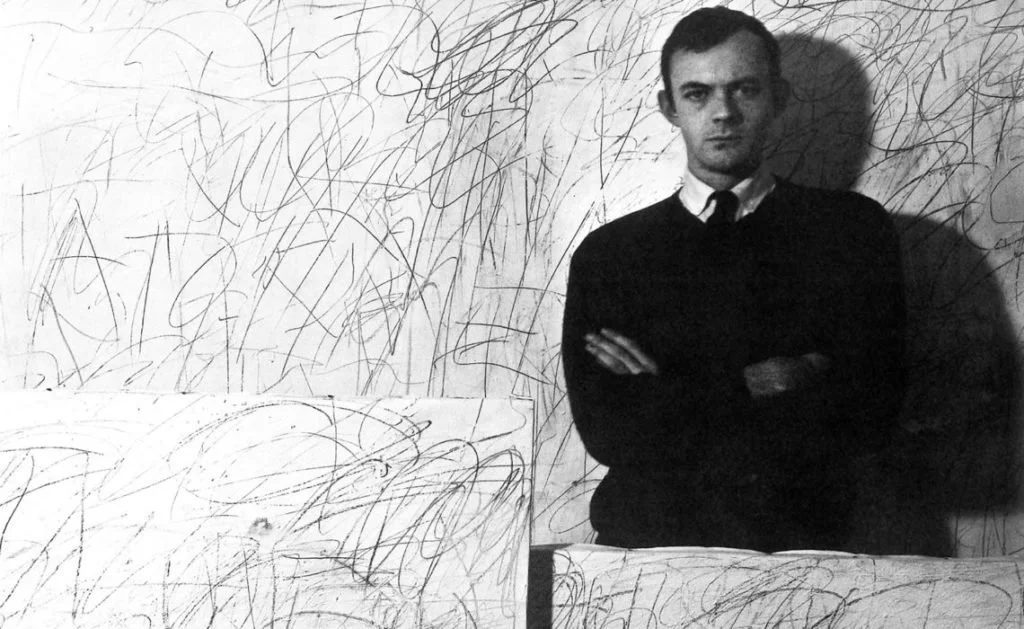
Cy Twombly in the Studio on William Street, New York City 1956 (self-portrait). Credit: Fondazione Nicola Del Roscio
On my first visit to the Art Institute of Chicago, I made a rookie mistake. I spent too long ambling through the Arts of Ancient Egypt and the Arts of the Greek, Roman, and Byzantine Worlds and ended up dashing between paintings in the Modern Wing — Kandinsky, Picasso, Miró — while the loudspeaker warned that the museum was in fact closed and I had better leave.
Despite my hurried state, I remember standing briefly before a large Cy Twombly painting and feeling time slow. For a moment, everything came to a halt. It was beautiful and surreal. And then I was out the door.
When I returned to the museum last month — seven years later — I was determined not to repeat my mistake. With ample time until close, I pushed through the large doors of the Modern Wing and was greeted immediately by a different, yet equally stunning Twombly. Awestruck, I stood as long as my heart desired, taking it in.
My wife texted a picture of the painting to a friend, notorious for his distaste of abstract art, asking, “Is it art?”
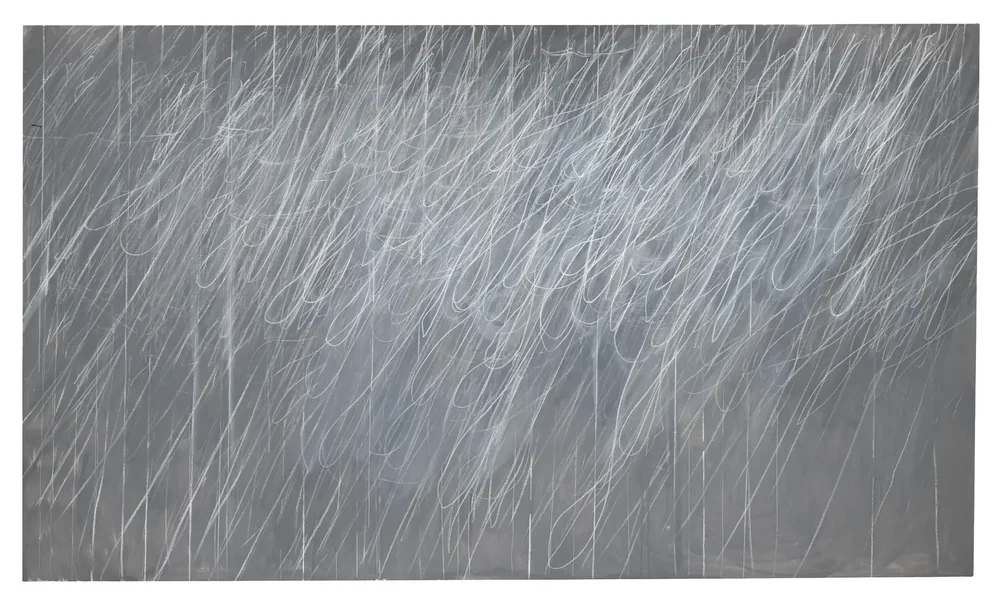
Cy Twombly, Untitled, 1971. Oil-based house paint and wax crayon on canvas, 80 x 134 5/8 inches. © Cy Twombly Foundation. Courtesy Gagosian. Photo: Maris Hutchinson.
Untitled
Like most of Twombly’s work the painting bears no title and is composed of a series of childlike lines. This particular Untitled is huge — in my mind, the dimensions of a full-sized soccer goal — and displayed by itself against an imposing, stark gallery wall. It’s one of many Twombly pieces with white chalk-like scribbles over a slate gray blackboard-like background. Playing on our memories of school, the paintings offer a sense of something academic yet naive — elementary yet scholarly.
There’s a rhythm in the lines. They start on the bottom left and arc up to the top before looping around and cascading back down — a cursive “l” drawn over and over, sprawling across the canvas, interrupted occasionally by chaotic strokes, partially erased or emboldened.
The big looping marks — their repetition and flow — are common across Twombly’s paintings. There is little that sets this iteration apart from dozens of others the artist produced around the same time.
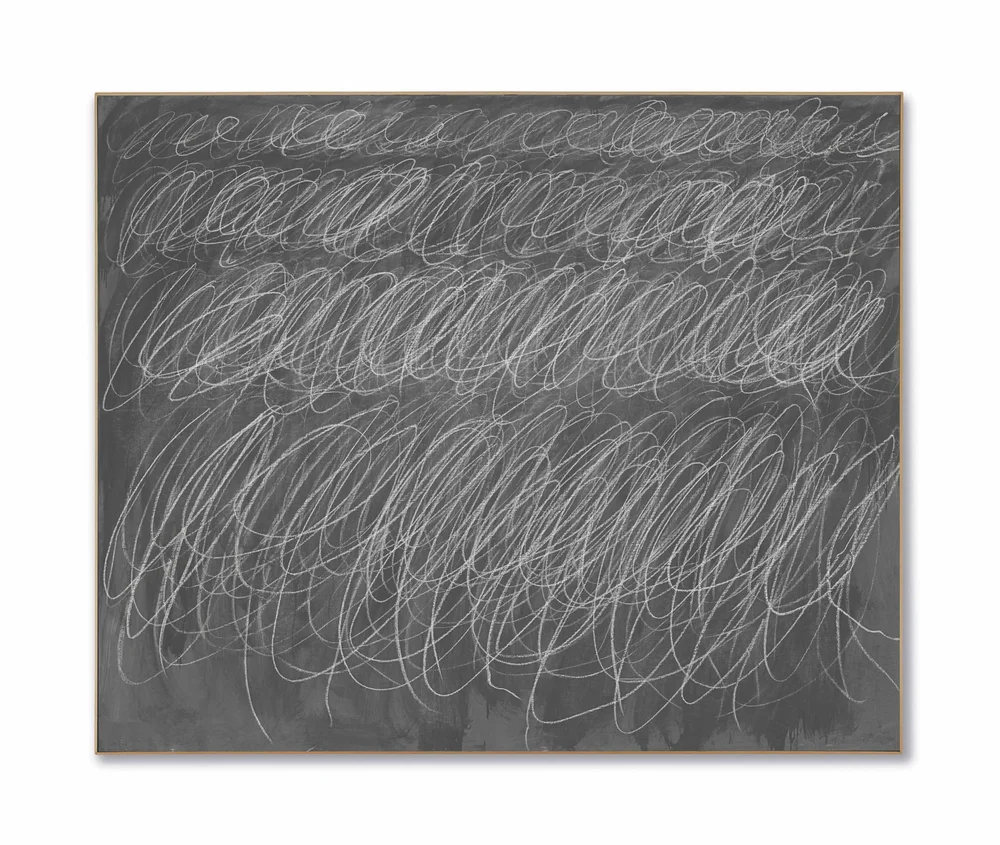
Cy Twombly (1928-2011) Untitled. Credit: Christies.com
“I feel like I am outnumbered here so I will keep my mouth shut, haha,” my friend wrote back.
Then… three dots emerged and I waited to see what apology he might have in store after further consideration.
“But I will say this…it’s garbage.”
Ouch.
All circles presuppose
I understand some people fail to see and feel whatever it is that I see and feel when I stand beneath a work of art like Untitled.
But I am interested in the why. Why does a big canvas filled with squiggles elicit such polar reactions? I don't know what it’s like to see Twombly’s work as garbage though I do know there’s merit to sticking myself in another pair of shoes and trying them on for size. And in some ways I’ve been doing that work over these last few months — reanalyzing my own preconceptions and biases towards the abstract. But for now, I’d like to explore the roots of my perceptions. Pick at their origins and make some connections in defense of myself. Not because anyone needs to hear it, but because I want to write it.
To begin, let’s push our way back out the doors of the Modern Wing, round a corner, and head down a flight of stars into the Arts of Asia.
There is a practice in Zen Buddhism called ensō where an artist draws a circle with one unbroken brush stroke. The action itself is as important as the resulting form. Ensō is a spiritual practice. It offers the artist a temporary doorway to meditative consciousness. The circle captures that fleeting moment of meditation, but also exists separately from the moment as a symbol of the universe.
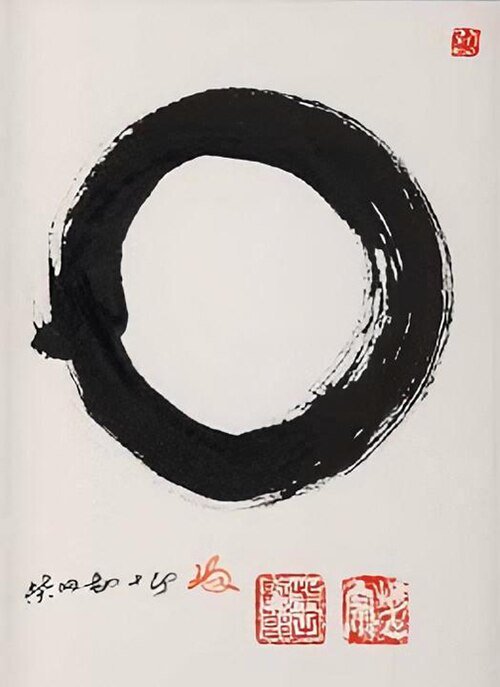
Ensō: The Zen Circle of Enlightenment. Credit: Kanjuro Shibata XX "Ensō via Wikimedia Commons
At once, ensō is a disciplined act of meditation, a record of a single human at a single point in time, and a reminder of the unending, cyclical nature of all things. In the particulars of the circle’s imperfection, is reference to a specific person, yet the openness of the circle evokes the universality of experience. In this way the particular and the universal are two sides of the same coin.
Now take that coin and put it in your pocket. You’ll need it later.
Poems as machines;
beer cans as poems
For the poet Matthew Zapruder the poem is a machine. He writes, “[A poem] happens first to the poet, and in the course of writing, the poet eventually makes something, a little machine, one that for the reader produces discoveries, connections, glimmers of expression.” In this metaphor, the poem is dependent on not only the poet, but also the reader. Without the reader, the machine doesn’t come to life. Responsibility lies with both parties.
It’s obvious to think of art in this way — as a point of connection between two people separated by time and activated by the viewer. What ensō does so wonderfully is strip things down. The action is all that remains. Through the reduction of the work to a single brush stroke, the viewer is asked with immediacy to acknowledge the brush, yes, but also the fingers, the hand, the human being — their breath and body, fears, dreams, secrets. How similar we might be. How different.
“Emily Dickinson is the Budweiser can you see when you think you’re all alone — left off a trail thousands of miles from any town,” Rob Moss Wilson writes in his poem ‘Thank Goodness,’ “forcing the realization: Not only has someone been here before, but they brought beer.”
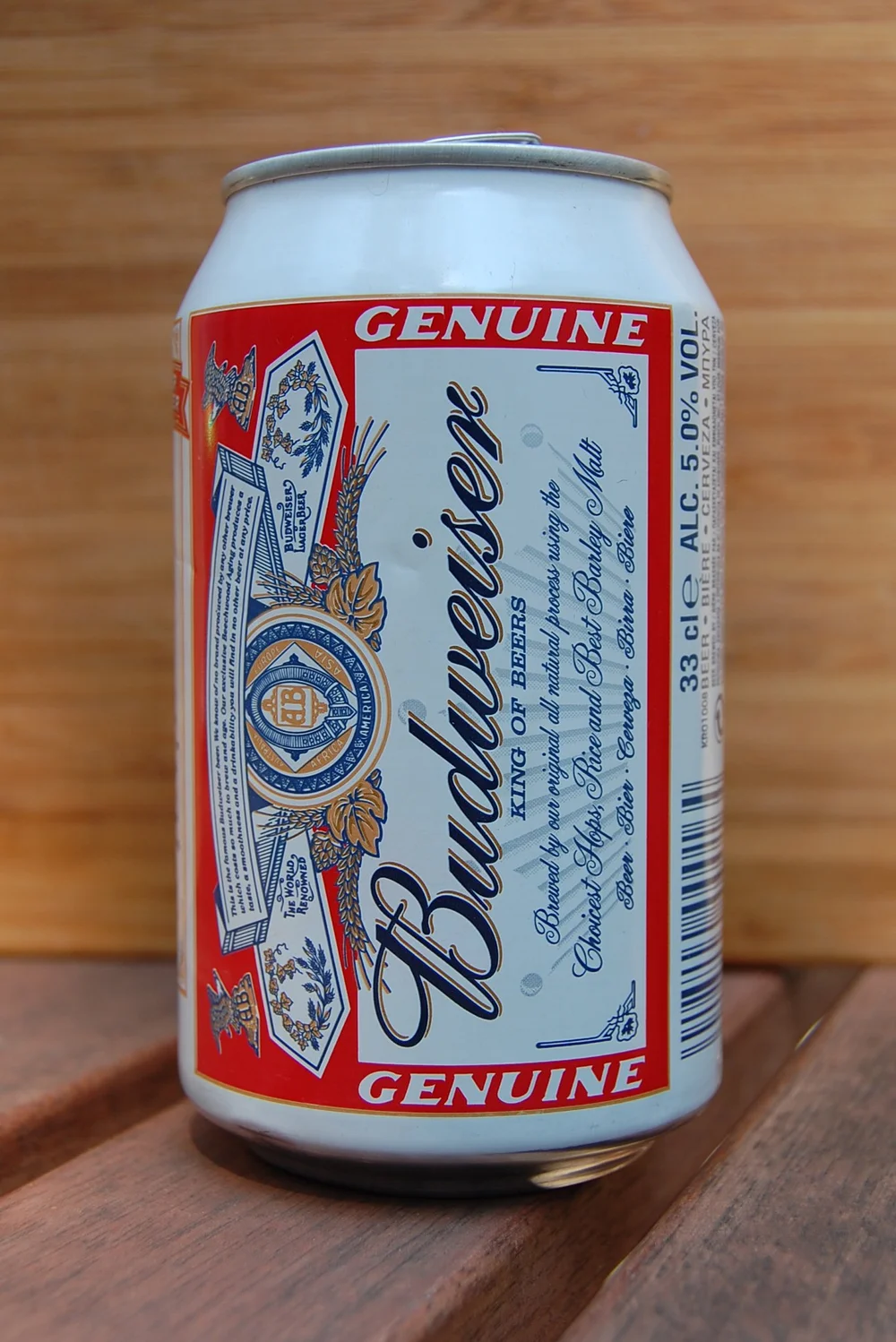
King of beers. Credit: Miquel C. via Wikimedia Commons
The world is littered with paintings, poems, and literal bits of debris like Wilson’s Budweiser can — artifacts harkening to their creator, while also keeping them out of reach. Someone sat right here, felt the sun on their face, cracked a cold one, and took in the view. We will never know them, but we are connected. Through a dented and discarded can, red label bleached white by the sun, we are connected.
In defiance of time and space, even the most mundane object can become a poem — can become one of Zapruder’s machines — and can open a temporary bridge between two people. As with ensō, these artifacts, whether poem or beer can, remind us that the universality of the human experience is found in the specific.
Tap your pocket. Coin still there?
So much of the world around us bears witness to those who have come before and offers the possibility of connection to the universal through special focus on the particular. While our metaphorical coin serves as a stand-in for the abstract concept of duality, a physical coin, smeared by a thousand hands, is a machine, a token that opens a bridge to other worlds and other times. If we let it be.
Circling back
The comparisons between Twombly’s Untitled and ensō are readily apparent. Both use simple minimal compositions to emphasize the action of the mark-making. Twombly’s arcing, repetitive strokes call to mind a zen practitioner incapable of letting the pen go after the singular, solemn flick. Instead, the artist holds on — swoops across the page again and again in desperation, confidence, or some combination of the two.
Where in ensō, enlightenment comes through restraint, Twombly seems keen to access no-mind through fixation and excess — a total lack of restraint.
For both ensō and Untitled, the bridge between artist and audience — the machine — depends on human action. Both capture the artist in a particular moment, opening us up to the human experience through the particularity of the brush’s movement. It's impossible to view Untitled without imagining the artist in motion. The viewer feels the body as it moves over the canvas. The simplicity and repetition of the strokes beckon to the body — Twombly’s height, the span of his arms, the bend of his elbows and knees — as it was in that moment and only that moment.
The brush strokes lie in wait, hiding behind the doors of the Art Institute’s Modern Wing. When the viewer encounters the painting, the machine turns on and the bridge opens up. Like me, Twombly had a body, and it was here and I am here. Briefly, we are connected. I am reminded of my own body — of everyone’s body.
The universal lies in the particular.
Spin the coin on the table; both sides are visible at once.
My two cents
For all my little words, it’s impossible to explain or rationalize the beauty of a painting or a poem — or a beer can for that matter. Upon viewing Twombly’s work, there is, for me, a numinous sensation of wonder and connection; transcendence — an instance of what the poet John Keats called “Negative Capability.”
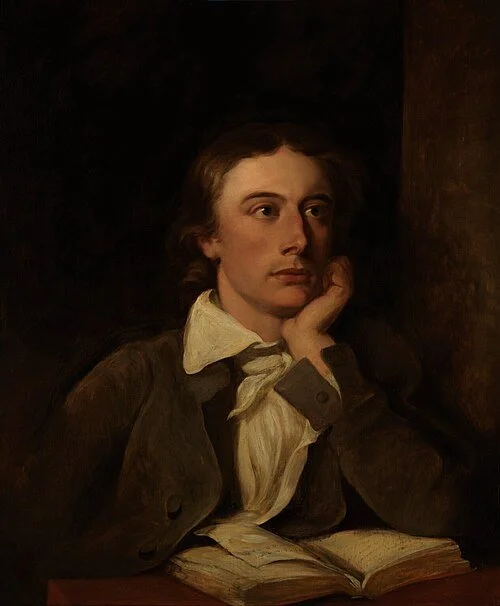
John Keats, by William Hilton (circa 1822)
Keats wrote to a family member that a great thinker is one who is, “capable of being in uncertainties, mysteries, doubts, without any irritable reaching after fact and reason.” Negative capability is recognizing something as beautiful and meaningful without the weight of needing to rationalize or explain it. To embody this state requires the suspension of judgement and the acceptance of ambiguity. It’s a skill. Thus it requires practice.
When we begin to practice, the world opens up. When we engage our negative capability, art becomes an invitation, rather than a challenge; and everything can become art. I have found that the more I suspend judgement and allow for ambiguity, the more I am able to answer these invitations. The more the bridges open. The farther they span. The longer they linger.
And that’s good. Because I refuse to let it not be good. But also because we need reminders of our bodies and their interconnectedness. We need to be shown repeatedly that we are blessed and cursed by the paradox of consciousness, the limits of language, and the frail power of our bodies. We are not alone.
Paintings don’t need explaining — not really. As Keats lets us know, most beautiful things don’t. Words have just as much tendency towards making meaning as obfuscating it, anyway. So, at the risk of muddying my own waters any further, I’ll leave you, reader, with a line from Robert Haas and the metaphorical coin in your pocket — my two cents.
“There are moments when the body is as numinous as words, days that are the good flesh continuing.”
